Scotogenic models and active learning
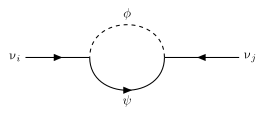
The scotogenic idea extends the SM by a dark sector odd under an exact discrete symmetry. The lightest -odd state is stable and provides a dark matter candidate, while the same -odd fields running in a one-loop diagram generate Majorana neutrino masses. The scan involves free parameters subject to stringent constraints, so a naive random scan is hopeless. The active-learning technique maps the exclusion frontier defined by the constraints. The scan couples two objects: the Oracle, the expensive but exact evaluator (SPheno and micrOMEGAs) that labels a point as “good” or “bad”, and the discriminator, a fast DNN trained to reproduce the Oracle’s decision, which then proposes new points to be labelled.
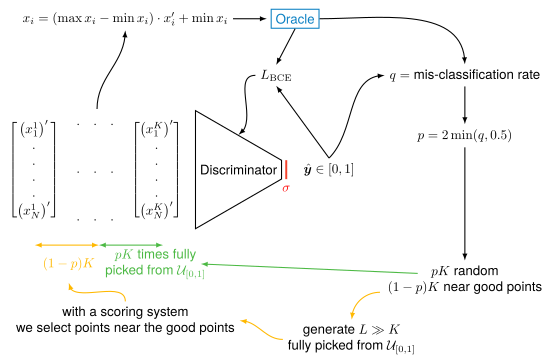
The term “active” refers to the fact that the discriminator actively selects the points it wants to learn from, rather than passively receiving a random sample. To avoid a hard cut, the Oracle assigns a continuous quality score, the geometric mean of the observables mapped to , and a point is labelled good if and bad otherwise.
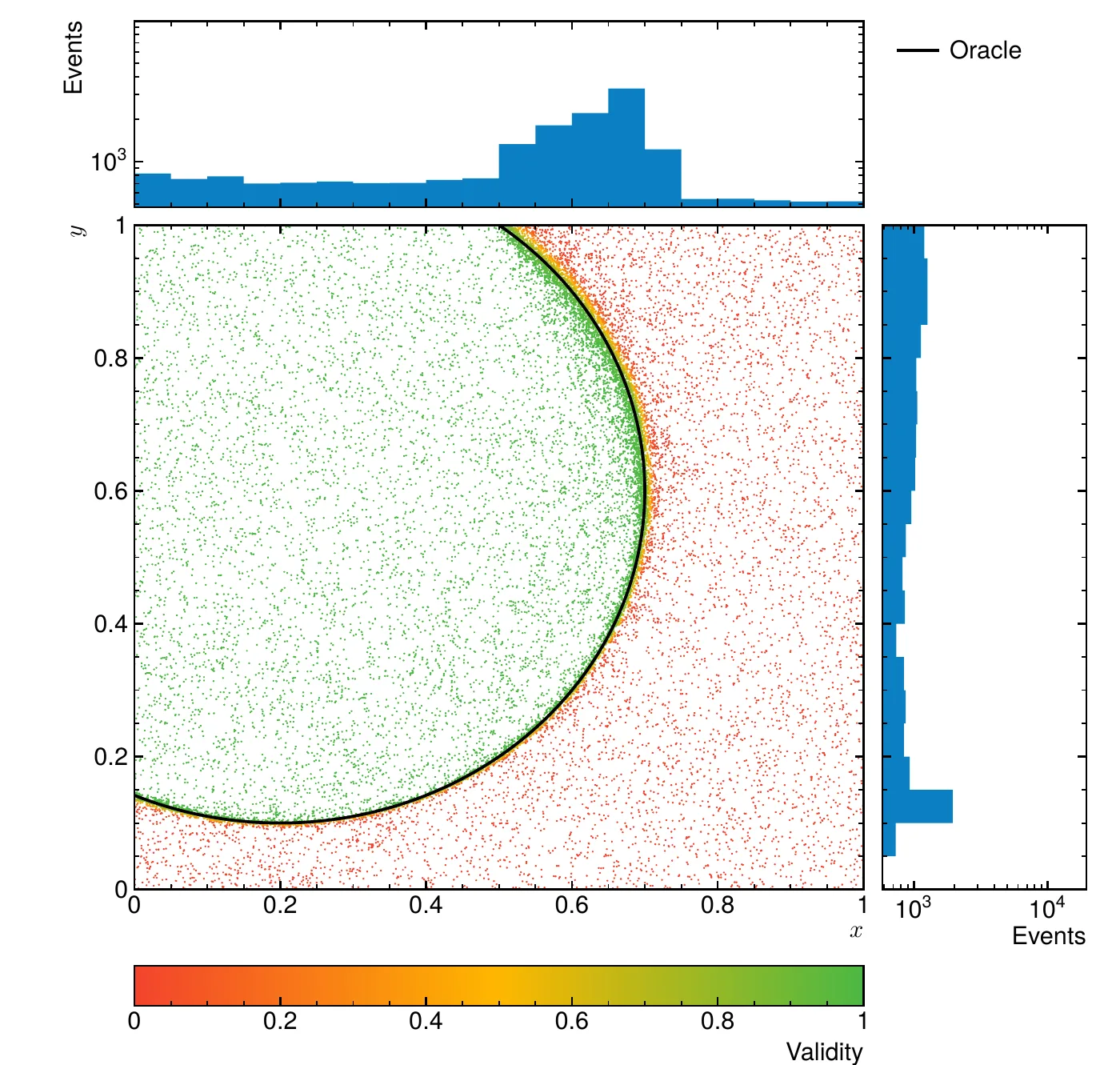
More: performance and outlook
Applied to the “T1-2G” model, the active-learning scan submitted points to the Oracle over weeks and retained good points. A natural improvement is a generative adversarial network whose generator, coupled to the trained discriminator, would propose good points directly, an avenue left to future work. Paper: arXiv:2512.06378.
Where it started
Master's internship (M1) at IP2I Lyon
Development of an active-learning method with DNN to scan efficiently the reduced phase spaces of the MSSM (pMSSM, NMFV), where a random scan almost never reaches points satisfying the constraints. Building on the work of M. Goodsell, the same approach was later adapted to supersymmetric parameter spaces of up to 45 dimensions and then to the scotogenic models above. A small version, redone in numpy →